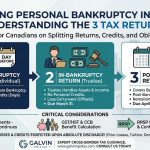

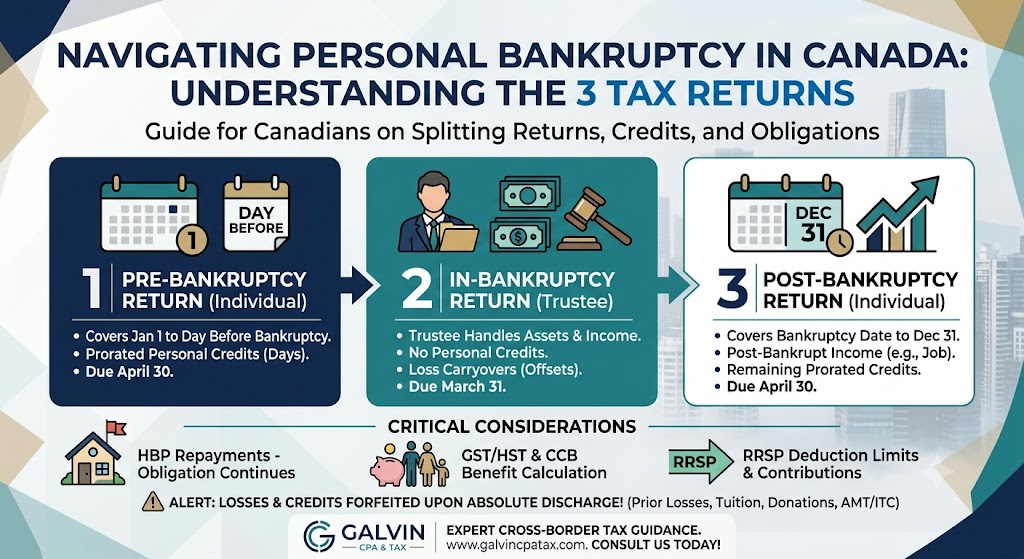
Declaring bankruptcy is a significant financial step, and its tax implications require careful planning. From a tax perspective in Canada, declaring bankruptcy in a given calendar year splits your income, deductions, and obligations across three distinct tax returns rather than a single annual filing.
At Galvin CPA & TAX, we guide individuals through complex Canadian and cross-border tax scenarios to ensure compliance and help you make informed financial decisions. Here is what you need to know about navigating tax returns during a bankruptcy year.
The Three Returns in the Year of Bankruptcy
In the calendar year you declare bankruptcy, three separate tax returns are typically involved:
- Pre-Bankruptcy Return (Individual): Your tax year is deemed to end the day before your declaration of bankruptcy. You must file a return covering this period by April 30 of the following year.
- Credits & Deductions: Non-refundable personal tax credits (such as the basic personal amount, age credit, and disability credit) are prorated based on the number of days in this period over the calendar year. Other credits—such as tuition, medical expenses, and CPP/EI contributions—are based on actual income or expenses incurred during this pre-bankruptcy period.
- In-Bankruptcy Return (Trustee): Filed by your Licensed Insolvency Trustee by March 31 of the following year, this return accounts for income generated from the trustee’s dealings with your property or business during the bankruptcy period.
- Key Rules: The trustee can apply loss carryovers to offset net income but generally cannot claim personal amount credits. Additionally, charitable donations made on or after the day of bankruptcy are claimed on this return.
- Post-Bankruptcy Return (Individual): Covering the period from the date of bankruptcy to December 31, this return covers income and transactions not included in the trustee’s return (such as post-bankruptcy employment income).
- Key Rules: Due April 30 of the following year, this return uses the remaining prorated portion of your personal tax credits. Loss carryovers cannot be claimed on this return.
Critical Tax Rules & Considerations
- Government Benefit Calculations: Income from both individual returns (pre- and post-bankruptcy) is combined to determine eligibility for benefits like the GST/HST credit and the Canada Child Benefit (CCB).
- RRSP Contributions & Limits: Despite splitting the year into pre- and post-bankruptcy periods, the CRA treats the two periods as a single taxation year for calculating RRSP deduction limits and contribution room. Contributions made during a period reduce available room sequentially.
- Home Buyers’ Plan (HBP) Repayments: Declaring bankruptcy does not erase your ongoing obligation to make annual HBP repayments. Because HBP repayment liabilities arise annually under Canadian law, they are not discharged through bankruptcy.
The Permanent Loss Trap: What Happens Upon Absolute Discharge?
When you receive an absolute discharge from bankruptcy, prior debt obligations to the CRA up to the bankruptcy date are canceled. However, receiving an absolute discharge also permanently eliminates several tax carryforwards.
Once an absolute discharge is granted, you permanently forfeit:
- Any unused tax losses (capital or non-capital) from years prior to the discharge.
- Unused tuition, education, and textbook amounts from pre-discharge years.
- Unused charitable donation carryforwards.
- Alternative Minimum Tax (AMT) and Investment Tax Credit (ITC) carryovers.
Planning Ahead with Galvin CPA & TAX
Filing multiple tax returns, correctly prorating personal credits, and coordinating with a Licensed Insolvency Trustee require precise accounting. Whether you are navigating individual tax compliance, business restructuring, or cross-border tax planning, Galvin CPA & TAX is here to help you stay compliant and protect your financial future.
Contact us today for a consultation on Canadian and U.S. tax planning and compliance.