
When a small business investment doesn’t go as planned, the Canadian tax system offers a powerful silver lining that many investors overlook. While typical capital losses are strictly limited, an Allowable Business Investment Loss (ABIL) can be your most valuable tax-planning tool.
At Galvin CPA & TAX, we help you navigate these complex rules to protect your cash flow when things get tough.
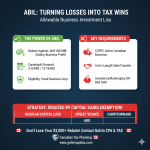
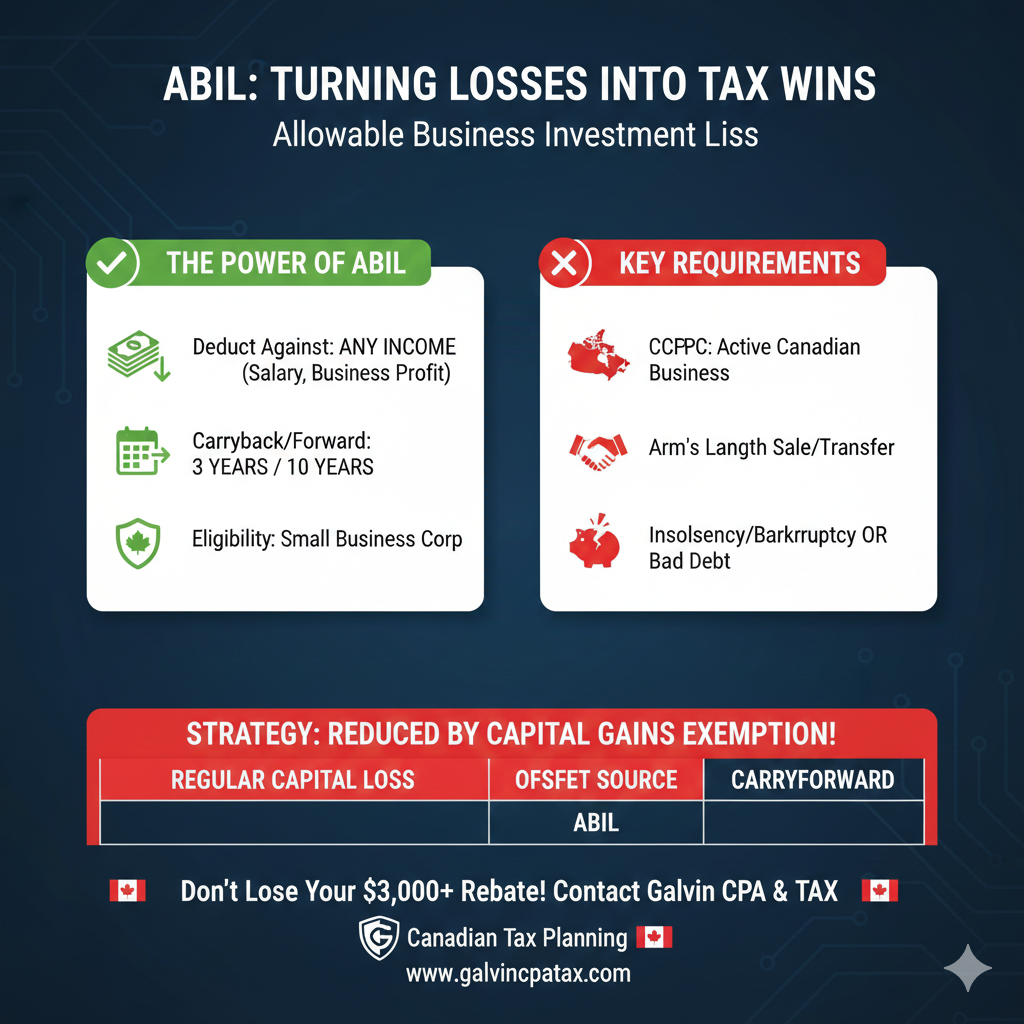
The Power of the ABIL
Usually, if you sell a stock at a loss, you must first use it to offset capital gains. If you have a remaining loss, it can only be used against other capital gains, not your regular income.
The ABIL changes the math:
- Deduct Against Any Income: An ABIL is a special type of capital loss that you can deduct from any source of income—including your salary or business profits—not just from capital gains.
- The Benefit: One-half of your actual business investment loss becomes an ABIL, providing a direct reduction to your total taxable income.
- Carryback and Carryforward: If you can’t use the full ABIL in the current year, you can carry it back 3 years or forward for 10 years to offset any type of income7. After 10 years, it converts into a regular net capital loss.
Does Your Investment Qualify?
To claim an ABIL, the loss must result from the disposition of shares or debt in a Small Business Corporation (SBC). The IRS (and CRA) have strict requirements for what qualifies:
- Canadian-Controlled Private Corporation (CCPC): The company must be a CCPC where “all or substantially all” (usually 90%) of its assets are used in an active business in Canada.
- Arm’s Length Requirement: The loss must generally occur on a sale to a person with whom you deal at arm’s length.
- Insolvency or Bankruptcy: You can also trigger an ABIL if the corporation has become formally bankrupt or effectively insolvent, provided you make the proper legal election.
- Bad Debts: If a small business owes you money that has become uncollectible, that debt may also qualify for ABIL treatment.
Strategic Planning for Investors
An ABIL is a significant tax advantage, but it is subject to specific “clawbacks” if you have previously benefited from the Lifetime Capital Gains Exemption.
- Reduction Rule: Your current ABIL will be reduced by the amount of any capital gains exemptions you have claimed in previous years.
- Documentation is Key: Establishing that a business is “insolvent” or that a debt is “uncollectible” requires credible evidence to satisfy the tax authorities17.
Summary: ABIL vs. Regular Capital Loss
| Feature | Regular Capital Loss | ABIL |
| Offset Source | Capital Gains Only | Any Income Source |
| Carryforward | Indefinite (Gains only) | 10 Years (Any income) |
| Eligibility | Most Capital Assets | Small Business Corp Shares/Debt |
Are you facing a loss on a small business investment or a loan that won’t be repaid? Don’t leave these tax savings on the table. Contact Galvin CPA & TAX today to review your investment documents and maximize your ABIL claim for the 2025 tax year.