
When a business undergoes restructuring or transfers assets between affiliated entities, it’s easy to assume that any resulting losses can be used to lower your tax bill. However, the Canada Revenue Agency (CRA) has strict Stop-Loss Rules designed to prevent taxpayers from “realizing” a loss for tax purposes while still effectively controlling the asset.
At Galvin CPA & TAX, we help you navigate these complex rules to ensure your corporate transitions don’t result in unexpected tax traps.
The Fundamental Rule: Denial and Deferral
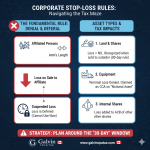
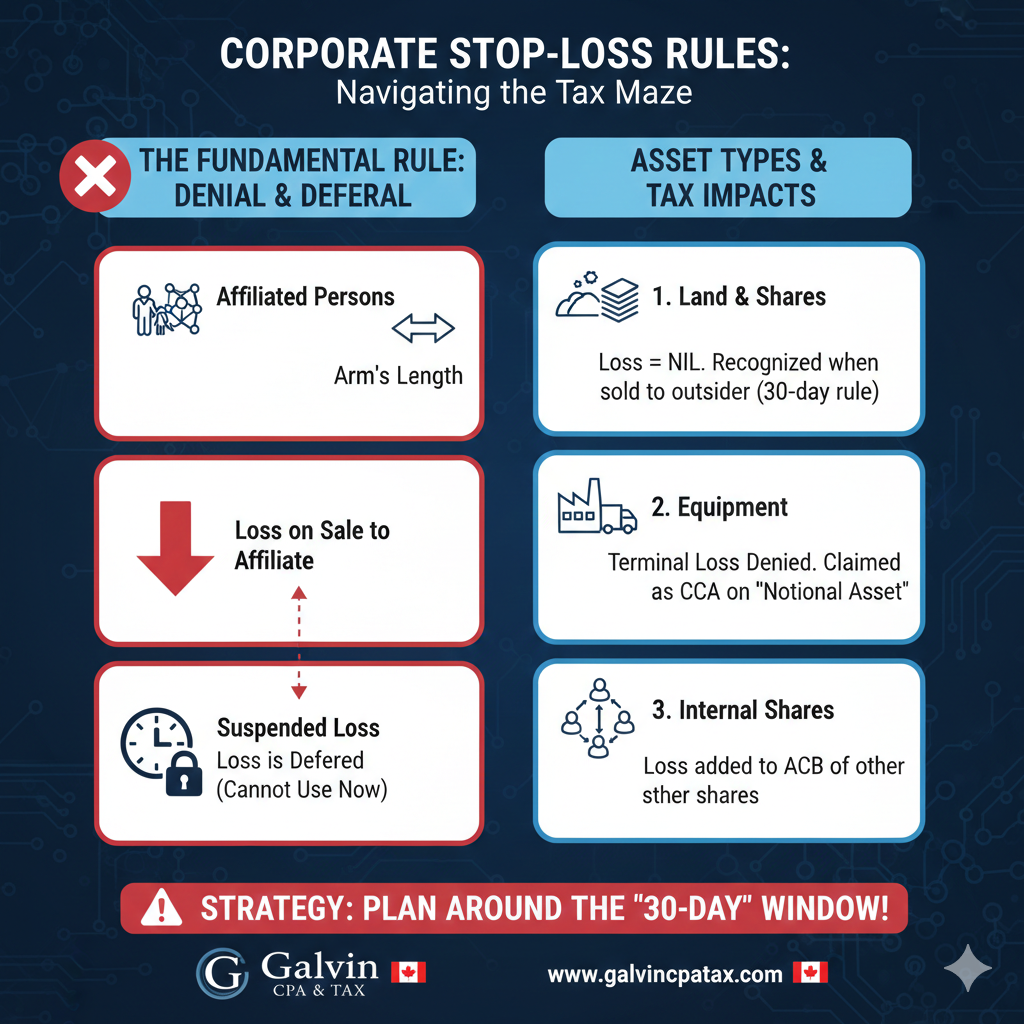
Essentially, the stop-loss rules (specifically subsection 40(3.4) of the Income Tax Act) deny a capital loss on the sale of property to affiliated persons. Instead of being immediately deductible, the loss is “suspended” or deferred until the asset is finally sold to a non-affiliated, arm’s length party.
What is “Qualified Property”?
These rules apply to two main categories of business assets:
1. Non-Depreciable Capital Property (e.g., Land or Shares)
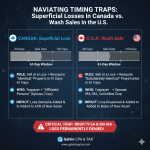
If a corporation or partnership disposes of capital property at a loss to an affiliate, and that affiliate still owns the property (or an identical one) 30 days after the sale, the loss is deemed to be nil for the transferor.
- The “Wait” Period: The loss remains with the transferor but cannot be used until neither they nor an affiliate owns the property for a full 30-day period.
- Trigger Events: Recognition of the loss can also be triggered by a change in control of the corporation or the commencement of a winding-up.
2. Depreciable Property (The Terminal Loss Trap)
When you sell all assets in a specific class (like equipment or vehicles), you normally realize a “terminal loss” if the remaining value in that class is greater than zero.
- The Denial: If these assets are transferred to an affiliate, the terminal loss is denied.
- The Notional Asset: The transferor is treated as still owning a “notional property” in that class with a cost equal to the denied loss. You can continue to claim Capital Cost Allowance (CCA) on this invisible asset until the original property is finally sold to an outsider.
Who counts as an “Affiliated Person”?
The definition of an affiliated person is broader than the standard “non-arm’s length” rules. It typically includes:
- Spouses or common-law partners.
- Controlled corporations and those controlled by a group of affiliated persons.
- Affiliated partnerships and trusts.
Strategic Planning: The “30-Day” Window
There are limited planning opportunities to avoid these rules. For example, in some trust wind-ups, if the recipient is no longer affiliated with the trust at the end of the 30-day period following a distribution, the stop-loss rule may not apply.
Summary: Stop-Loss Impact Table
| Asset Type | Immediate Impact | Eventual Recognition |
| Land/Shares | Loss is Deemed Nil | Triggered by final arm’s length sale |
| Equipment | Terminal Loss Denied | Claimed as CCA on “notional” asset |
| Internal Shares | Loss Added to ACB of other shares | Recognized when remaining shares are sold |
Are you planning a corporate reorganization or the sale of business assets to a related entity? At Galvin CPA & TAX, we can perform a “Stop-Loss Review” to determine if your planned transaction will trigger these deferral rules. Contact us today to optimize your loss utilization strategy.