
When selling investments to harvest a tax loss, the timing of your next move is everything. Both the Canadian and U.S. tax systems have “anti-avoidance” rules designed to prevent taxpayers from claiming a loss while maintaining their economic position in an asset.
At Galvin CPA & TAX, we help cross-border investors navigate these rules to ensure your losses remain deductible on both sides of the border.
1. Canada: The Superficial Loss Rule
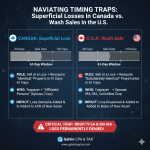
In Canada, a loss is “superficial” if you sell an asset to trigger a tax benefit but effectively keep your position.
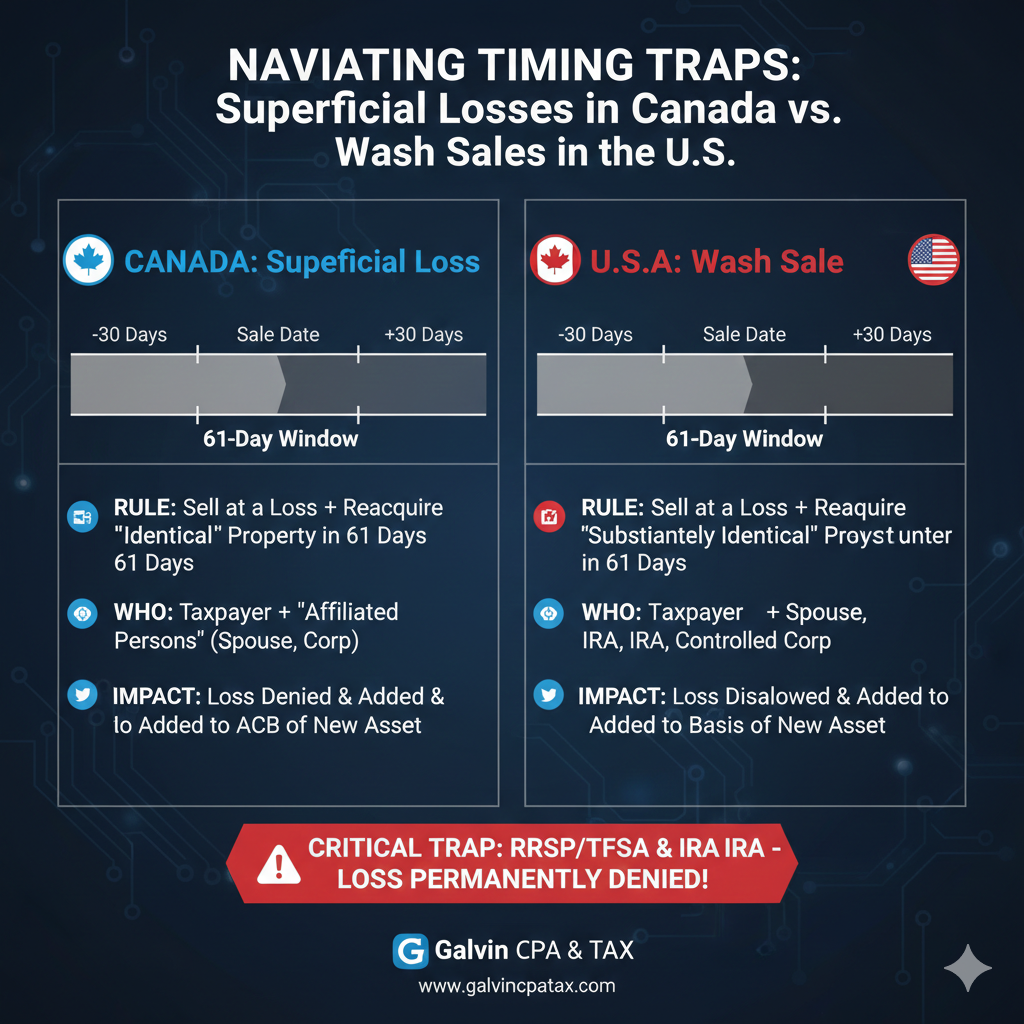
- The 61-Day Window: The rule applies if you or an affiliated person (spouse, controlled corporation, or certain trusts) acquires the same or “identical” property within 30 days before or 30 days after the sale.
- The Ownership Test: The loss is only denied if you or an affiliate still own (or have a right to acquire) that property 30 days after the sale.
- The Benefit (ACB Adjustment): The denied loss is not gone forever; it is added to the Adjusted Cost Base (ACB) of the newly acquired property, reducing your future tax when you eventually sell it to an outsider.
2. United States: The Wash Sale Rule (Section 1091)
The U.S. equivalent is the Wash Sale rule, which functions similarly but has several key differences in how it defines “identical” and who it affects.
- The Window: Like Canada, the U.S. uses a 61-day window (30 days before/after the sale).
- The Scope: While Canada looks at “affiliated persons,” the U.S. rule primarily focuses on the taxpayer and their spouse, but can also extend to IRAs and controlled entities.
- “Substantially Identical”: The U.S. standard of “substantially identical” property can be broader than the Canadian “identical property” test, often catching different series of bonds from the same issuer or stock options.
- The Consequence: Similar to Canada, the loss is disallowed for the current year and added to the basis (cost) of the new stock.
Cross-Border Comparison: Superficial Loss vs. Wash Sale
| Feature | Canada (Superficial Loss) | United States (Wash Sale) |
| Window | 30 Days Before / 30 Days After | 30 Days Before / 30 Days After |
| Identical Property | Strict “Identical” standard | “Substantially Identical” standard |
| Affiliated Persons | Spouse, controlled corps, trusts | Spouse, IRAs, controlled entities |
| Permanent Loss? | YES, if transferred to RRSP/TFSA | YES, if reacquired in an IRA |
| Impact | Loss added to ACB | Loss added to Basis |
The Permanent Loss Trap: RRSPs, TFSAs
A critical difference for Canadian taxpayers is the treatment of registered accounts.
- The Rule: If you sell a security at a loss and immediately buy it back within your RRSP, TFSA, or FHSA, the loss is deemed nil.
- The Danger: Unlike a standard superficial loss between non-registered accounts, this denied loss cannot be added to the cost base of the asset in the registered plan. The tax benefit is lost permanently.
Strategic Planning: The “31-Day” Rule
To successfully harvest a loss, you must ensure a clean break:
- Wait it Out: Ensure neither you nor your spouse buys the asset back for at least 31 days after the sale.
- Avoid Identity: In Canada, you can often sell one ETF and buy a similar (but not identical) ETF tracking a different index to stay in the market without triggering the rule.
- Check Exemption Status: Remember that the rules do not apply to deemed dispositions at death or when emigrating from Canada.
Are you managing a portfolio across both U.S. and Canadian accounts? At Galvin CPA & TAX, we ensure your tax-loss harvesting strategy complies with both the Superficial Loss and Wash Sale rules. Contact us today for a year-end review.