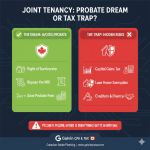

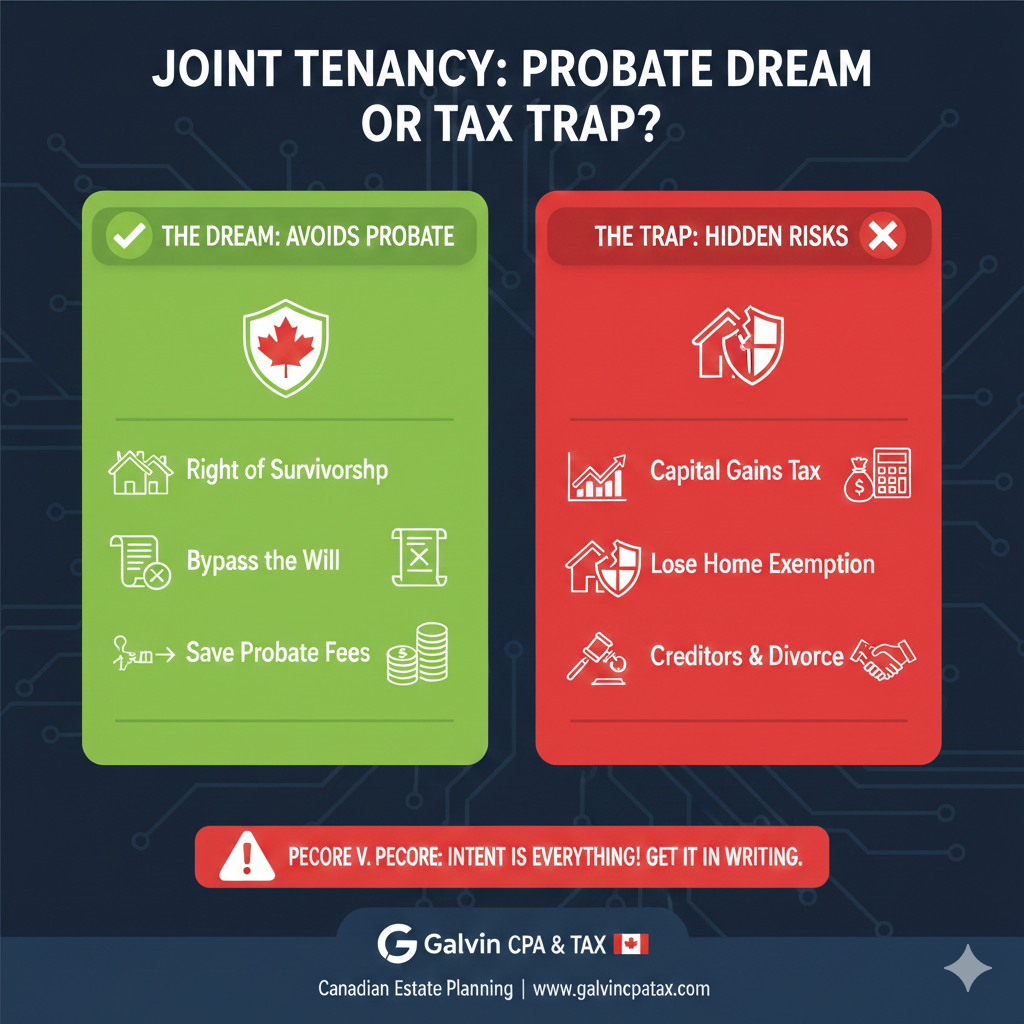
In Canadian estate planning, “joint tenancy” is often hailed as a magic wand to bypass the complexities of a will. By adding a family member—usually an adult child—to the title of your home or bank account, you enable the right of survivorship, allowing the asset to pass directly to them and avoid the reach of provincial probate fees.
However, this “simple” strategy is fraught with hidden legal and tax complications that can lead to unintended consequences.
The “Four Unities” of a True Joint Tenancy
For a joint tenancy to be legally valid in Canada, four specific conditions—known as the Four Unities—must exist simultaneously:
- Unity of Title: All owners must derive their interest from the same legal document (e.g., the same deed).
- Unity of Time: Every owner’s interest must start at the exact same moment.
- Unity of Interest: Each owner must have an identical type and duration of interest (e.g., you can’t have one owner with a 75% share and another with 25%).
- Unity of Possession: Each owner has an undivided right to possess the entire property; no one can be excluded from any part of it.
The “Pecore” Warning: Presumption of Resulting Trust
A landmark Supreme Court of Canada case, Pecore v. Pecore, fundamentally changed how joint accounts between parents and adult children are viewed.
- The Rule: When a parent adds an adult child to an account for free (a “gratuitous transfer”), the law presumes no gift was intended. Instead, it is presumed the child is holding that asset “in trust” for the parent’s estate.
- The Burden of Proof: To keep the asset after the parent dies, the child must prove with “clear and convincing evidence” that the parent truly intended to give them a gift of the right of survivorship.
- The “Dream” Scenario: Pecore confirmed you can gift the right of survivorship (so the asset avoids probate) without giving away beneficial ownership during your lifetime. This means you keep control of the money while you’re alive, but it still skips the probate process when you pass.
Three Major Risks You Must Consider
1. The Tax Trap: Deemed Sale & Lost Exemptions
Adding a child (other than a spouse) to a property’s title can trigger an immediate deemed sale of a portion of that asset at its current market value.
- Capital Gains: If the asset has appreciated, you may owe capital gains tax on the portion “sold” to your child.
- Principal Residence: If you add a child to your home’s title, you may lose part of your Principal Residence Exemption. Any future appreciation on the child’s portion of the home could be taxable when the house is eventually sold.
2. Creditors and Marital Claims
Once your child is on the title, your asset is no longer just yours. It becomes vulnerable to creditor claims or marital disputes involving your child. If your child goes through a divorce or bankruptcy, a portion of your home or account could be seized to settle their debts.
3. Land Transfer Tax
In Ontario, transferring an interest in real estate to a child can attract land transfer tax if the property is currently subject to a mortgage.
Summary Table: Joint Tenancy Checklist
| Potential Benefit | Hidden Risk |
| Avoids Probate Fees (e.g., 1.5% in Ontario over $50k) | Triggers Deemed Sale (Immediate capital gains tax) |
| Simple Transfer (Assets pass automatically) | Legal Vulnerability (Exposure to child’s creditors/ex-spouses) |
| Retain Lifetime Control (Per Pecore ruling) | Loss of Primary Residence Status on child’s portion |
Is joint tenancy the right “probate planning dream” for your family, or a high-stakes gamble? At Galvin CPA & TAX, we help you document your intentions to satisfy the Pecore standards and analyze the hidden tax costs of a transfer. Contact us today for an estate planning review before you sign any deeds.