
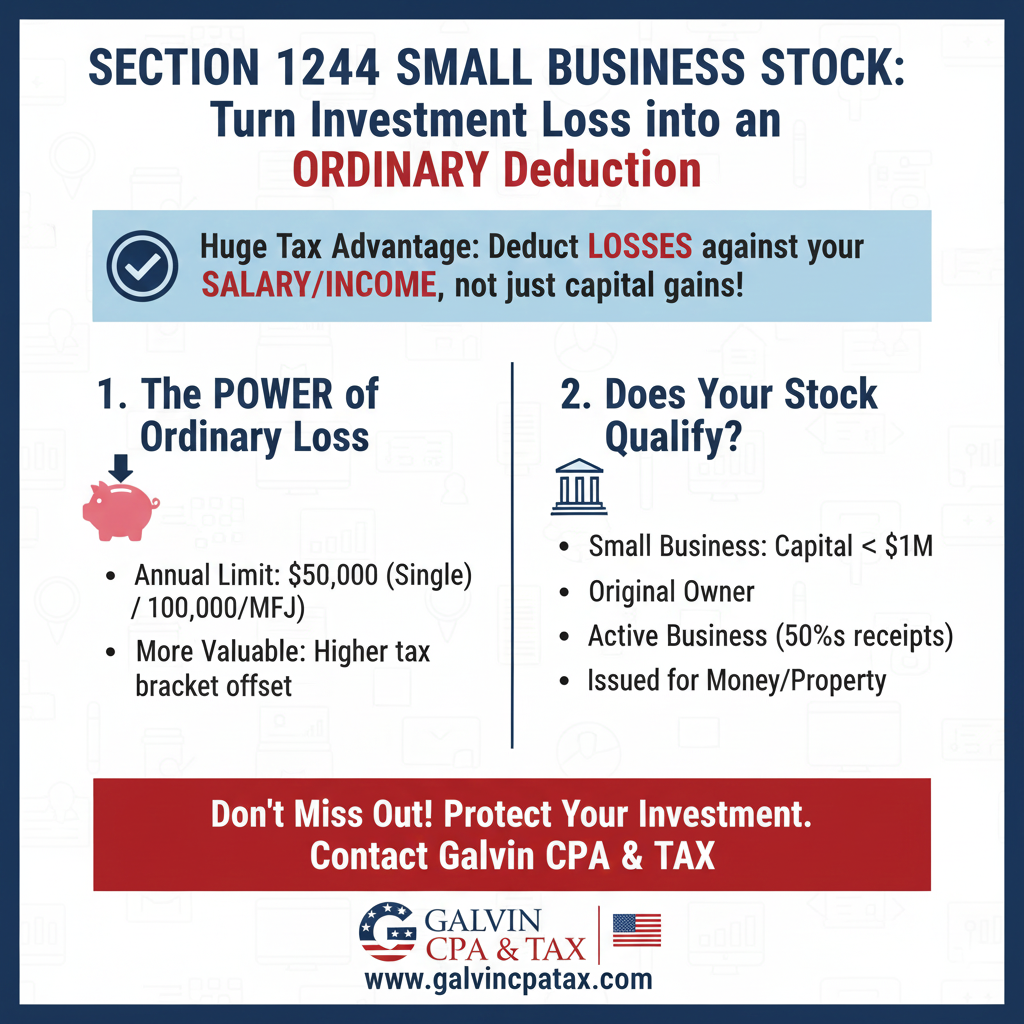
When a small business investment doesn’t go as planned, the IRS offers a silver lining that most investors overlook. While typical investment losses are capped at $3,000 against your ordinary income, Section 1244 stock allows you to transform a major “capital loss” into an “ordinary loss”.
At Galvin CPA & TAX, we want to ensure you understand how to leverage this powerful provision to protect your cash flow.
The Power of the Ordinary Loss
Usually, if you sell a stock at a loss, it is a capital loss. You must first use it to offset capital gains, and if you have a remaining loss, you can only deduct $3,000 per year against your salary or other income.
Section 1244 changes the math:
- Deduction Limits: You can deduct up to $50,000 (or $100,000 on a joint return) as an ordinary loss each year.
- The Advantage: Because ordinary income is often taxed at a higher rate than capital gains, this deduction is significantly more valuable than a standard capital loss.
- The Best of Both Worlds: While losses get favorable “ordinary” treatment, any gains on the sale of Section 1244 stock are still treated as favorable capital gains.
Does Your Investment Qualify?
To claim this special treatment, the corporation and the stock must meet several strict requirements at the time the loss occurs:
- Small Business Status: The corporation’s total capital (money and property received for stock) cannot exceed $1,000,000.
- The “Original Owner” Rule: You must be the original owner of the stock. If you bought the shares from another shareholder rather than directly from the company, you do not qualify for Section 1244 treatment.
- Active Business Test: For the five years leading up to the loss, the corporation must have derived more than 50% of its gross receipts from active business operations, rather than passive sources like rents, royalties, or dividends.
- Issued for Value: The stock must have been issued in exchange for money or property. Stock issued in exchange for other stock or securities generally does not qualify.
Strategic Planning for Small Business Owners
Section 1244 is an “automatic” benefit if you meet the requirements, but documentation is key. If you are starting a new venture or investing in a startup, ensuring the stock is properly issued for cash or property can save you tens of thousands of dollars in taxes if the business fails.
Key Takeaways for Your Return:
- Joint Filers: Even if only one spouse owns the stock and incurs the loss, the full $100,000 annual ordinary loss limit applies to your joint return.
- Partnerships: If a partnership owns the stock, the individual partners can claim the ordinary loss, provided they were partners when the stock was issued and remained partners until the loss occurred.
Are you facing a loss on a small business investment and wondering if it qualifies for Section 1244 treatment? Contact Galvin CPA & TAX today. We can help you review your issuance documents and maximize your deduction for the 2025 tax year.